A quotation can call a paddle "full carbon" while listing only a carbon shaft. The blade may have a carbon-look surface, the handle material may be missing, and the connection hardware may sit outside the description entirely. The price looks precise. The construction does not.
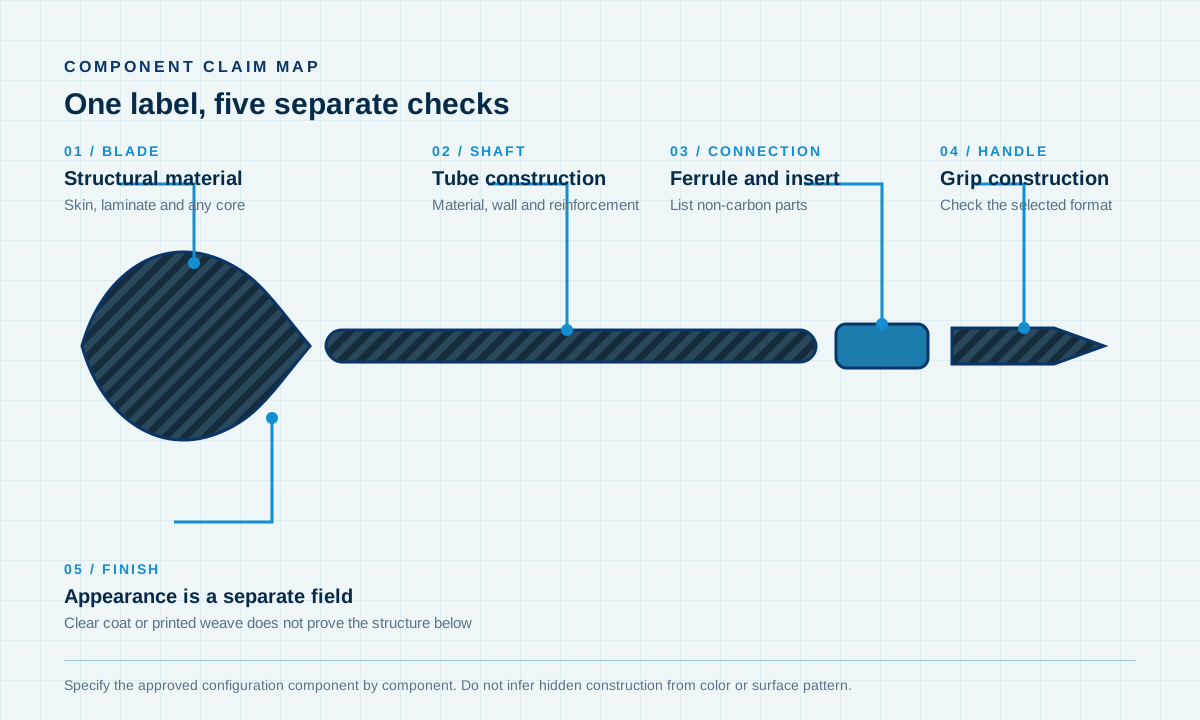
Treat full carbon as a claim that needs a written boundary. At minimum, confirm the structural material of the blade and shaft, then identify the handle, ferrule, inserts, core, coatings and adhesive separately where they affect the approved configuration. Appearance cannot close those gaps.
When I review this wording, I ask the supplier or buyer to stop using the label for a moment. We list the parts first. Once the blade, shaft and connection are clear, it becomes much easier to decide whether "full carbon" is accurate, qualified or better replaced.
01 / Claim boundary
What should "full carbon" mean in a paddle specification?
For a practical paddle specification, full carbon should mean that the approved blade and shaft use carbon-fiber-reinforced construction, with the remaining parts identified rather than hidden by the label.
A paddle is an assembly, not a single material. A SUP paddle may include a blade, shaft, T-handle, adjustment mechanism and bonding areas. A kayak paddle adds a second blade and often a ferrule. Screws, pins, surface coatings, adhesives and small inserts can remain non-carbon without making the component description dishonest, provided the specification says what they are.
That component approach matches the existing paddle materials and construction guide, which separates blade, shaft, connection and finish. It also prevents a common purchasing mistake: reading a carbon option in one catalogue column as if it automatically applies to the complete paddle.
The US Federal Aviation Administration describes composite materials as fiber-reinforced matrix systems in its Pilot's Handbook of Aeronautical Knowledge. The matrix holds the fibers together and gives the cured part its shape, while the fibers carry much of the load. The handbook concerns aircraft, not paddles, but its basic definition is useful here: a carbon composite is not a piece of pure carbon.
02 / Surface evidence
Why can't a carbon weave prove the complete paddle construction?
A weave pattern can show the approved surface appearance, but it cannot identify every layer, hidden core, shaft wall, insert or connection material in the finished paddle.
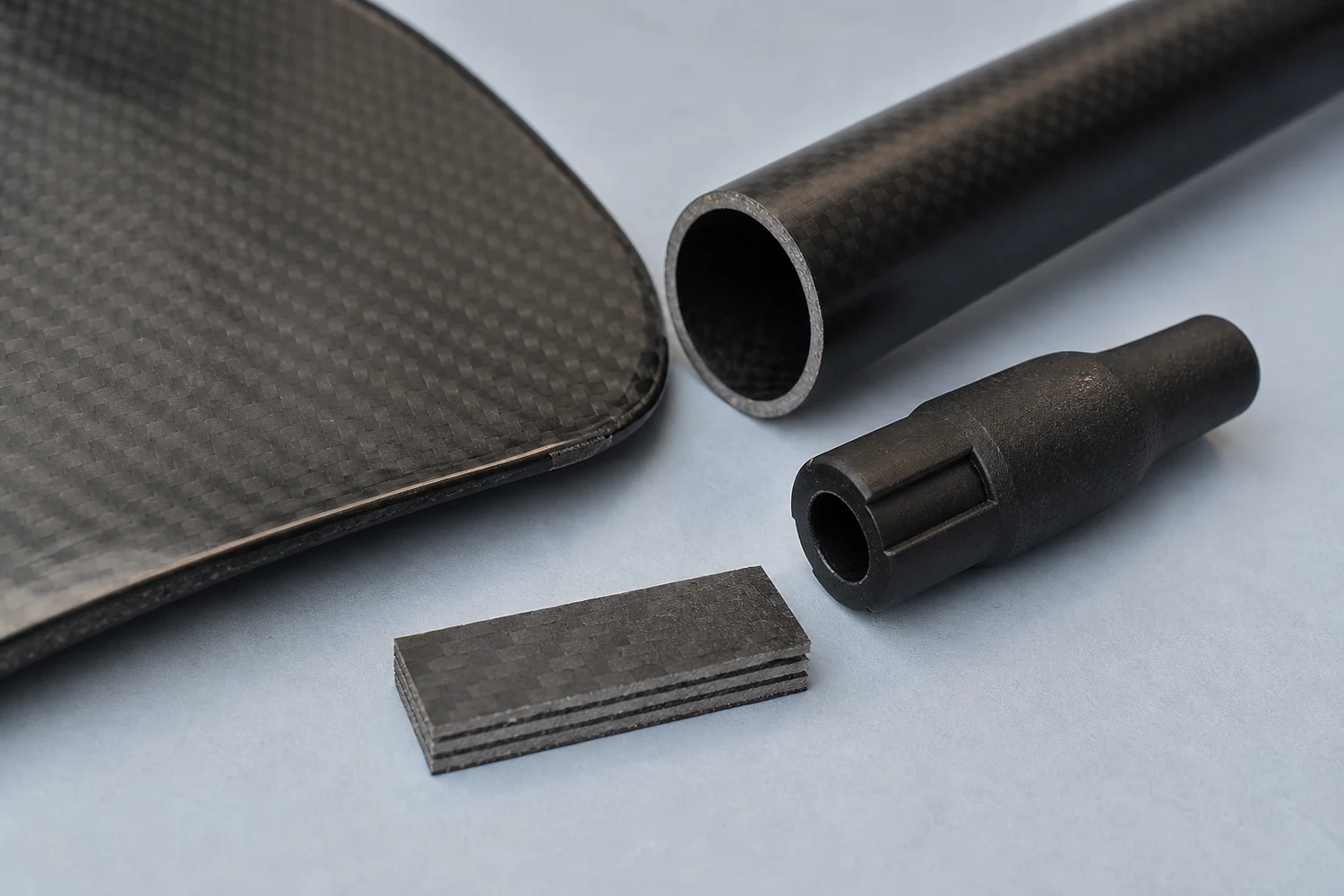
A cosmetic print may imitate a weave. A real carbon outer ply may sit over another reinforcement or a core. A clear coat can also change how the fabric looks without changing the structural schedule underneath. None of those possibilities can be resolved from a marketplace thumbnail.
Use photography to approve color, gloss, weave direction and visible finish. Use the written component specification to approve construction. If a cut edge or sample coupon is available, it can support the conversation, but it should not be treated as proof that an entire production batch uses the same internal structure.
03 / Wording check
Which carbon paddle terms should a buyer keep separate?
Keep commercial labels tied to the component they describe. "Carbon shaft," "carbon blade" and "full carbon" should lead to different specification fields, not three interchangeable ways to describe the same photo.
| Quoted term | What it may describe | What remains unconfirmed | Safer specification wording |
|---|---|---|---|
| Carbon look | Color, printed pattern or visible surface | Structural material below the finish | Carbon-look finish on the named component |
| Carbon reinforced | A material containing carbon reinforcement | Reinforcement form, amount and other constituents | Name the component and supplier-defined construction |
| Carbon shaft | The selected shaft tube | Blade, handle, ferrule and inserts | Carbon shaft with separately named blade and connection |
| Carbon blade | The selected blade construction | Shaft, handle and connection | Carbon blade with separately named shaft |
| Full carbon | Normally the primary structural blade and shaft components | Boundary of the claim and minor non-carbon parts | Define every included component and list exclusions |
These are working procurement definitions, not a claim that one universal paddle-labeling standard controls every market. Your product page, purchase specification and approved sample should use the same boundary. If the label needs a footnote to stay accurate, add it.
04 / Evidence level
What evidence should buyers request before sampling?
Start with evidence that identifies the actual product, then increase the verification level only when the claim, order risk or contract justifies it. A laboratory method cannot rescue a vague model reference.
- Level 01Quotation gate
Component declaration
List blade, shaft, handle, connection, core, inserts and finish for the quoted model. Mark unknown items instead of filling them with assumptions.
- Level 02Sample gate
Controlled specification
Attach the component construction to a drawing, bill of materials, model sheet or supplier-controlled record with a revision identifier.
- Level 03Release gate
Approved product reference
Compare dimensions, weight range when agreed, assembly, finish and visible details with the written specification. Photograph the approved configuration if that helps repeat orders.
- Level 04Evidence gate
Defined material or product test
Use a named method, sampling rule, conditioning and acceptance criterion when a quantified claim or higher-risk program requires more than document and sample control.
The CPSC's voluntary manufacturing best practices recommend detailed specifications, supplier controls and documented due care for consumer products. Applicable legal duties still depend on the product and destination market. The useful sourcing principle is to keep the product claim attached to controlled records.
05 / Test boundary
When does a carbon-content claim need laboratory testing?
Use laboratory testing when the contract requires a quantified constituent value or when the commercial risk warrants independent verification. Do not request a generic "carbon test" without deciding what material, component and result the test must address.
ISO 14127:2024 specifies methods for determining resin, fiber and void contents in carbon-fiber-reinforced composites. ASTM D3171 also provides constituent-content test methods for composite materials. Both references make an important distinction: fiber, matrix and void content are measurable characteristics. The phrase "100% carbon paddle" is not a substitute for one of those measurements.
Those methods may require specific specimen preparation and can be destructive. A result from a coupon or cut component must also be connected to the production material and sampling plan. Buyers should not assume that a single supplier sample proves every paddle in a shipment.
What constituent or laminate characteristic needs verification?
Which blade, shaft, coupon or production lot supplies the sample?
Which current standard and laboratory procedure apply?
What acceptance limit and report will the buyer use?
If the project records a measured weight, dimension or test result, state the instrument, method and sample. NIST explains that metrological traceability applies to a documented measurement result through a chain of calibrations. The word "calibrated" beside an unnamed tool is not enough on its own.
Material-content evidence also does not predict the complete paddle's flex, balance, impact behavior or service life. Those outcomes depend on geometry, laminate design, joints and test conditions. If performance matters, define a finished-product test separately.
06 / Approval record
What should the RFQ and approved sample record about carbon construction?
Record one component-level construction for one identified model, then carry that same wording into the quotation, sample approval and production release.
Paddle family, model, drawing, sample reference and section format
Construction, profile, dimensions, core or reinforcement note when relevant
Construction, diameter, shape, length and adjustment format
Handle, ferrule, inserts, fasteners, adhesive and stated exclusions
Weave direction, color, gloss, artwork and surface reference
Weight or dimensions when agreed, sample checks and any named test method
For an OEM program, the sample and customization review should resolve this construction before marketing copy is finalized. If the approved sample changes from a carbon blade to a fiberglass blade, update both the specification and the product claim. Do not leave the old label in the catalogue because the surface still looks similar.
The same rule applies when shortlisting a model from the Vision Sports paddle families. Catalogue materials show available directions, not permission to combine every blade, shaft and connection. Confirm the selected configuration during quotation and sampling.
Buyer questions
Frequently asked questions about full-carbon paddles
Does a carbon shaft make a paddle full carbon?
No. A carbon shaft describes one component. Identify the blade, shaft, handle and connection separately. If the blade is fiberglass, molded plastic or another material, describe the product as a carbon-shaft paddle rather than a full-carbon paddle.
Can buyers identify carbon fiber from the weave pattern?
A visible weave can support an appearance review, but it cannot prove the construction of every component or any material hidden below the surface. Confirm the component specification and approved sample instead of relying on color or pattern alone.
Does full carbon mean the paddle is made from pure carbon?
No. A carbon-fiber-reinforced polymer contains carbon reinforcement and a polymer matrix. Finished components may also include coatings, adhesives, hardware, cores or inserts. The commercial term needs a stated component boundary.
Does every full-carbon paddle need a laboratory material-content test?
No. The evidence level should match the commercial claim, order risk and buyer requirement. A clear component specification and controlled sample may be enough for many projects. If a quantified fiber, resin or void value is required, name the test method and sampling plan before production.
What should be approved for a full-carbon OEM paddle?
Approve the model, blade construction, shaft construction, handle and connection materials, section format, dimensions, weight range when required, finish, artwork, packaging and any defined verification method. Keep the written specification and physical sample on the same revision.
Conclusion
Can the approved paddle be called full carbon?
Use the label only after the blade and shaft construction are confirmed for the approved model and the remaining component boundary is written down.
If that sentence feels awkward in the specification, use the more precise component wording instead. "Carbon shaft with fiberglass blade" is clearer than a full-carbon claim that needs explaining later. Good product language should survive the quotation, sample review and repeat order without changing meaning.